
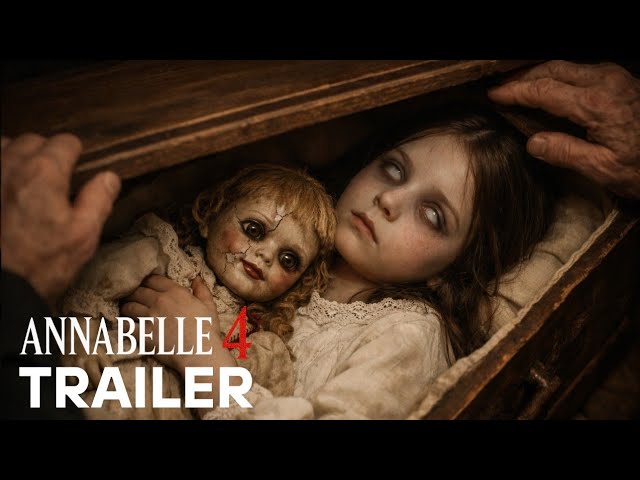
Annabelle 4: Silent Fear (2026) plunges audiences back into the suffocating darkness of the cursed doll’s legacy, but this time the terror is quieter, colder, and far more psychological than ever before. Set years after the previous hauntings thought to be contained, the film opens in a remote countryside estate swallowed by fog and silence, where a grieving family unknowingly becomes the next target of a malevolent force that no longer relies on noise or chaos—only stillness. The doll appears not as an immediate threat, but as an eerie observer, always present in the background, its glassy eyes fixed, its stitched smile unchanged, yet radiating a presence that makes every room feel inhabited by something unseen. Instead of sudden scares, the film slowly tightens its grip through dread, using silence as a weapon that feels more oppressive than any scream.

What makes this chapter deeply unsettling is how it transforms fear into something intimate and psychological. Strange occurrences begin subtly: clocks stop at the same second every night, reflections lag behind movements, and whispers echo in empty hallways where no one stands. The youngest child in the house starts drawing images of a faceless girl with sewn lips, insisting she has a “quiet friend” who never speaks but always watches. As the parents dismiss these signs as trauma-induced imagination, the audience is dragged into a suffocating tension where the horror lies not in what is seen, but in what is implied. The film masterfully builds an atmosphere where silence becomes heavier than sound, and every pause feels like a warning of something approaching.

As the haunting intensifies, the narrative delves into the disturbing mythology of “silent possession,” a chilling concept suggesting that the demon behind the doll no longer needs violent manifestations to claim a soul—it simply waits for emotional vulnerability. Nightmares bleed into reality, and the house itself begins to feel alive, with doors opening without sound and shadows forming shapes that vanish when directly observed. One of the most haunting sequences involves a dinner scene where the entire family sits frozen for several seconds, unaware that time itself has subtly warped while Annabelle sits at the end of the table, repositioned without anyone noticing. The horror becomes existential, questioning perception, memory, and the fragility of sanity under supernatural influence.

Midway through the film, a paranormal investigator connected to past cursed artifacts arrives, revealing that the doll was never truly dormant—only waiting for a host whose silence could be broken from within. The film cleverly intertwines emotional trauma with supernatural horror, suggesting that the entity feeds on suppressed grief and unspoken fear. Flashbacks expose the tragic origin of the spirit bound to the doll, hinting at a ritual designed to create obedience through silence, symbolized by recurring imagery of stitched mouths and blank expressions. This psychological layering elevates the story beyond traditional jump-scare horror, turning it into a slow descent into dread where every character’s emotional weakness becomes an entry point for the entity’s influence.

The final act escalates into a nerve-shredding confrontation that abandons loud spectacle in favor of suffocating tension. Instead of explosive exorcism scenes, the climax unfolds in near-total silence, broken only by faint breathing and the creaking of the house as if it were alive. The child, now eerily calm, becomes the center of the entity’s ritual, forcing the family into a desperate choice between sacrifice and survival. The film’s most terrifying moments come from stillness—long takes where nothing happens, yet everything feels wrong—creating a lingering dread that seeps into the viewer’s subconscious long after each scene ends.

By the time the film reaches its haunting conclusion, Annabelle 4: Silent Fear proves to be one of the darkest and most atmospheric entries in the franchise, shifting the focus from traditional possession chaos to psychological torment and emotional horror. It leaves audiences with an unforgettable final image: the doll sealed away once more, sitting quietly in darkness… yet its eyes appearing slightly shifted, as if it never truly stopped watching. Rather than delivering simple scares, the film lingers like a whisper in the mind, reminding viewers that the most terrifying evil is not the one that screams—but the one that waits in perfect silence.